
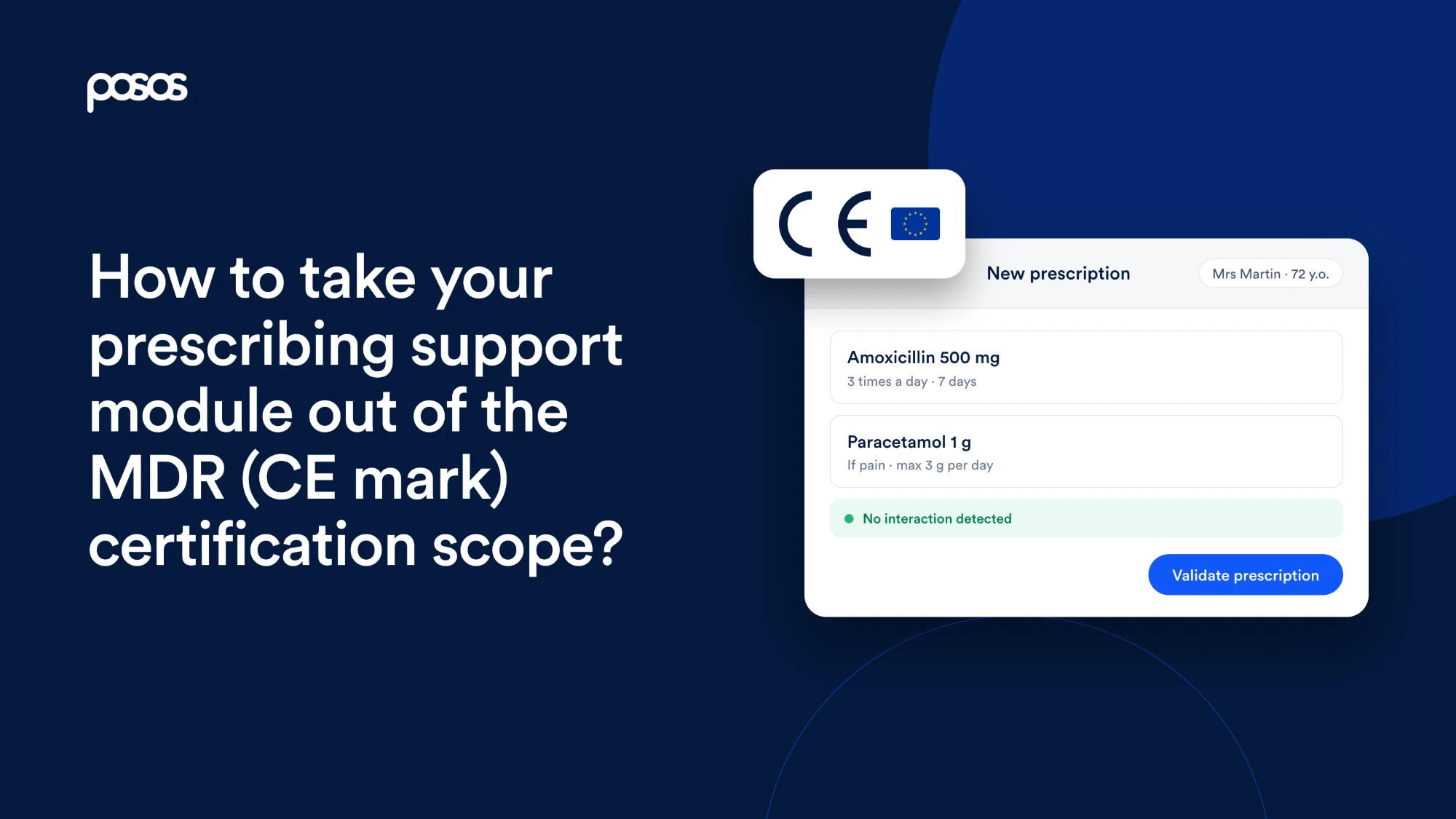
How to take your prescribing support module out of the MDR (CE mark) certification scope?
There is a countdown affecting most medical software vendors, and a key date looming over them: end of 2028. That is when the transitional periods of the MDR, the European Medical Device Regulation, come to an end. But what matters is not the date itself, it is what needs to be done before then. And depending on whether you are launching a new product or evolving software already on the market, the path, and its cost, are not the same.
Summary
For new entrants
If your software's features fall within the scope of a medical device, the rule is harsh but clear: no CE mark, no market access. No transitional period protects you; you start directly under the MDR and must be compliant before you sell.
One clarification, since the question comes up often: Class I remains self-declared, with no notified body involved. But very few healthcare software products qualify, and certainly not a clinical decision support system. Under MDR Rule 11, such software is classified as Class IIa or IIb: self-declaration is not a way out.
For established players
The heaviest burden falls on players already on the market. If you sell software placed on the market under the former Directive 93/42/EEC, you are engaged in the transition to the MDR, with a firm deadline of 31 December 2028. Many of these products were also self-declared as Class I; under Rule 11, they move up to Class IIa or IIb. This change of class now requires certification by a notified body, and therefore a much more substantial file, to be compiled before a date that will not move.
Long lead times, limited capacity
Certification takes time: 9 to 24 months in practice. Partly because of the very limited availability of notified bodies: barely fifty for all of Europe and all medical devices. A revision of the regulation, proposed in late 2025 to make these timelines more predictable, is a step in the right direction, but it has not yet been adopted and is not expected for several months.
And it would be wrong to think that the length of the process depends mainly on the notified body. The groundwork, including compiling the technical documentation on the manufacturer's side, is substantial and far more time-consuming than the notified body's review itself.
The fast track, for newcomers and incumbents alike
A large share of this workload is concentrated in a single part of your product: the one carrying the most risk, which pushes your class upward. It is also the part you don't have to build yourself. At Posos, it is already done. Our AORT and ARP devices, which detect and correct drug interactions, contraindications, allergies and intolerances, adverse effects, dosages and therapeutic duplications, are Class IIb software, CE-marked under the MDR (notified body GMED), with the associated quality management system and post-market surveillance. Several market players already rely on them.
By integrating this building block rather than maintaining it yourself, you simply become its distributor, not its manufacturer, and you take the most demanding function out of your certification scope. The time saved is immediate: new entrants significantly shorten their time-to-market, while established players secure their 2028 deadline instead of racing against it.
Key takeaways
- The deadline that matters: the end of the transitional periods, end of 2028, for devices placed on the market under the former directives.
- New entrants: compliance required from day one; no CE mark = no market. Class I self-declaration is not possible for decision support software.
- Established players: beware the change of class (from I to IIa or IIb), which requires a notified body.
- Certification takes 9 to 24 months, capacity is scarce, and the MDR revision has not yet been adopted.
- The fast track: rely on an already-certified building block, a time saver for newcomers and incumbents alike.
Preparing your MDR transition? Our AORT and ARP devices are already CE-marked: you integrate them, you remain a distributor. Book a demo of the Posos API.
Sources
Regulations (EU) 2017/745 and 2023/607; European Commission, evaluation and proposed revision COM(2025) 1023 (Dec. 2025); software qualification: MDCG 2019-11 and Rule 11, Annex VIII; notified body capacity and lead times (Team-NB / European Commission).
